Curcumin: A True Powerhouse of Antioxidant and Anti‑Inflammatory Support
What Is Curcumin?
If you're familiar with traditional Chinese medicine, you've probably heard of turmeric (Jiang Huang). It has over a thousand years of documented use — in texts like the Chinese Materia Medica, turmeric is described as a remedy for "promoting blood flow, clearing stagnation, and relieving pain."

Turmeric belongs to the ginger family. Originally prized for its captivating aroma and widely used as a spice, its earliest recorded medicinal use actually dates back to ancient India. There, people believed this "golden" powder had remarkably broad healing properties. It was traditionally used for liver diseases, digestive issues, infectious diseases, and even various blood disorders – many of which were extremely difficult to treat at the time.
After turmeric spread from China to Japan, it became known as a "miracle remedy" for hangovers and pain relief. In particular, it was unexpectedly effective at relieving the after‑effects of heavy drinking. [1][2]

In 1815, two German scientists were the first to isolate curcumin, the primary active compound in turmeric. However, for more than a century after its discovery, curcumin remained largely overlooked. That changed in the 1990s, when curcumin's research journey took off like never before.

Over the following decades, research continued to expand. For example, between 2015 and 2020 alone, over 6,000 papers on curcumin were published. Today, more than 10,000 research studies have been published, including nearly 200 large‑scale clinical trials involving human participants.
This surge in research was driven by two key factors. First, rapid advances in life sciences allowed researchers to better understand diseases at the cellular and genetic levels — uncovering the genes and biological pathways influenced by curcumin. Second, scientists gradually developed ways to improve curcumin's bioavailability in the body, leading to a renewed appreciation of its potential health benefits.
In short, published clinical studies on curcumin cover an impressively broad range of health conditions, including:
Various cancers, such as breast, lung, prostate, and multiple myeloma
Neurodegenerative diseases, such as Alzheimer's disease
Cardiovascular conditions, such as atherosclerosis and acute coronary syndrome
Skin disorders, such as vitiligo and psoriasis
Inflammatory diseases, such as gastric ulcers, irritable bowel syndrome, osteoarthritis, ulcerative colitis, bacterial prostatitis, and cholecystitis
Metabolic disorders, such as diabetes and lupus nephritis
…and many others.
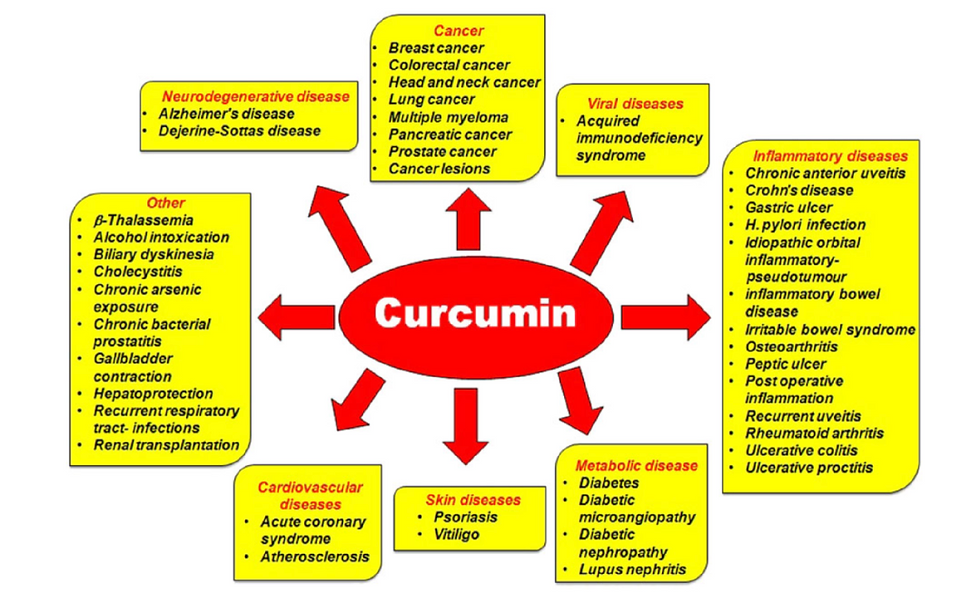
In addition, curcumin has also been shown to help with various forms of chronic toxicity, such as heavy metal exposure and alcohol-related toxicity. In many ways, it's like yeast beta‑glucan: a seemingly endless treasure trove of potential health benefits.
An Important Note:
Despite all the research surrounding curcumin, it accounts for only about 1–4% of turmeric. The rest consists of a complex mixture of naturally occurring compounds, including sterols, alkaloids, and other bioactive ingredients.
How Curcumin Works at the Molecular Level
The reason curcumin has such a wide range of clinical benefits is that it can influence an unusually large number of biological pathways and genes.
In 2017, scientists from the MD Anderson Cancer Center and other research institutions jointly published a comprehensive review on curcumin's effects across various chronic diseases. The article detailed how curcumin influences key genes and signaling pathways throughout the body. [4]

Curcumin can regulate the expression of a remarkably wide range of genes — affecting transcription factors, inflammatory mediators, protein kinases, and various other proteins.

These include genes such as Nrf2, NF‑κB, MAPK, COX‑2, PGE2, FOXO3, VEGF, NOS, among many others.
Take p53, for example – one of the most remarkable genes in cancer biology. Often regarded as one of the greatest discoveries in cancer research, p53 is a tumor suppressor gene that controls whether a cell divides. That's why it's often called the "guardian of the genome," and why many targeted cancer therapies are closely linked to it.
In cancer patients, p53 mutations are found in more than half of cases. Even in people with chronic inflammation–a condition that can compromise long-term health–p53 activity is often reduced. This is where curcumin comes in. Research suggests it can help boost p53 expression, which enhances the body’s surveillance of tumor cells, and promotes apoptosis of such cells (programmed cell death). [5]

In other words, curcumin may be able to effectively "flip the switch" on tumor cells by modulating p53 — turning it on or off as needed.
Clinical Benefits of Curcumin
Anti‑Inflammatory Effects
Among curcumin’s many studied clinical benefits, its anti‑inflammatory effects are perhaps the most worth highlighting — even surpassing well‑known compounds like vitamin C, quercetin, and beta‑glucan. Curcumin can downregulate a broad range of inflammatory cytokines — including TNF‑α, IL‑1, IL‑6, IL‑8, IL‑12, MCP‑1, and IL‑1β — along with various inflammation‑related proteases and transcription factors. [6][7]
A significant portion of clinical research has focused on osteoarthritis and rheumatoid arthritis. For osteoarthritis, we've previously recommended boswellia and glucosamine, which work by modulating the 5‑LOX signaling pathway to reduce inflammation. However, curcumin has an even larger body of clinical evidence supporting its use. [8][9][10]
For example, one multicenter randomized controlled trial found that taking 1,500 mg of curcumin daily achieved the same level of improvement as the NSAID ibuprofen — making it a compelling natural alternative. [11]

Clinical studies have also extensively covered various digestive tract inflammations — including gastritis, ulcerative colitis, and pancreatitis. At daily doses ranging from 500 mg to 2 g, curcumin has been shown to relieve pain, reduce abdominal discomfort, and help prevent recurrence. [12][13][14]
In addition, curcumin has demonstrated supportive benefits for oral and gum health in clinical settings — such as inhibiting the growth of pathogenic bacteria in the mouth and helping prevent gingivitis.
Key Takeaway
Unhealthy lifestyles and poor dietary habits can contribute to chronic low‑grade inflammation throughout the body. Finding effective and safe ways to manage inflammation — through diet or supplements — has long been a worthwhile goal. Hopefully, more ingredients like curcumin will continue to be discovered and brought to light.
Cholesterol & Lipid Support
Clinically, curcumin has also been used as a supportive intervention for cardiovascular disease, as it helps lower LDL cholesterol, triglycerides, and total cholesterol. [15][16][17][18]
Compared to EPA, curcumin appears to have a broader lipid‑lowering profile — it not only targets LDL and triglycerides, but it also helps raise HDL cholesterol levels.
Liver - Protective Effects
We've previously discussed silymarin as a powerful liver protectant. Curcumin is equally impressive — but unlike silymarin, which is highly liver‑specific, curcumin is more of a "generalist" that supports multiple organs. As a result, its liver-supporting benefits are often overlooked.
Curcumin can help with a wide range of liver stressors — including alcohol- and medication- related liver injury, smoking-related oxidative stress, fatty liver disease, and hepatitis.
For example, research suggests curcumin can help reduce oxidative stress in liver cells while improving mitochondrial function, helping to suppress hepatic inflammation. In clinical settings, encapsulated curcumin has been shown to delay the progression of non‑alcoholic fatty liver disease by lowering inflammatory cytokine levels. [19][20]
Supporting Healthy Blood Sugar
Curcumin has been shown to influence α‑glucosidase and α‑amylase activity, helping to improve insulin sensitivity and enhance insulin secretion. [21]
In a randomized, double‑blind, placebo‑controlled trial, 100 patients with type 2 diabetes who took curcumin for 12 weeks showed reduced levels of fasting blood glucose, insulin resistance (HOMA‑IR), and triglyceride (TG) levels. [22]
Another randomized, double‑blind trial involving 237 prediabetic participants found that taking 250 mg of curcumin daily significantly reduced HbA1c and fasting blood glucose at 3, 6, and 9 months. It also reduced the rate of progression to type 2 diabetes from 16.9% in the placebo group to 0% in the curcumin group. Additionally, curcumin significantly lowered HOMA‑IR at 6 and 9 months, and reduced elevated lipoprotein levels at 9 months. [23]
Supporting Cancer Defense
For cervical cancer, both oral and topical application have shown promise. One clinical study found that daily oral intake of 500–1,200 mg of curcumin provided significant preventive effects against cervical cancer. [24]
Another Phase II trial showed that topical curcumin‑based products were effective at clearing HPV in patients with HPV‑positive cervical cancer. [25]
Colorectal cancer is also an area with substantial clinical data. In a trial involving 44 patients with colorectal cancer, researchers found that oral curcumin (2 g or 4 g daily for 30 days) showed strong preventive potential — increasing blood curcumin levels and significantly reducing the number of aberrant crypt foci (ACF), a biomarker for colorectal cancer risk. [26]
In another trial with 126 colorectal cancer patients, curcumin substantially reduced blood levels of the inflammatory cytokine TNF‑α within just 2–4 weeks of supplementation — offering meaningful support for concurrent treatment and overall disease management. [5]

There are also numerous studies on other cancers. Curcumin has been shown to lower levels of key factors — including NF‑κB, COX‑2, and phosphorylated STAT3 — in peripheral blood mononuclear cells of pancreatic cancer patients. [27]
It has also been found to reduce inflammatory markers such as IL‑6, IL‑8, GM‑CSF, and TNF‑α in patients with head and neck cancer. [28] In breast cancer, curcumin may help enhance drug sensitivity and reduce treatment‑related side effects. [29][30]
Summary
If there's one ingredient that rivals beta‑glucan — offering broad health applications, widespread recognition and use, and a strong balance of safety and efficacy — it would have to be curcumin.
The studies we've highlighted today, spanning major health conditions–including cancer–likely represent less than 1% of the total clinical research on curcumin. Even so, they illustrate the growing recognition of curcumin’s clinical potential.
That said, curcumin is not a miracle cure or a magic bullet. Its power lies more in supporting the body's own immune response — through anti‑inflammatory and antioxidant effects — while helping to reduce side effects and improve the absorption and efficacy of other treatments.


Comments