How to Take NMN for Optimal Results!
Not seeing results from NMN? That's because taking it isn't enough—you need to get it circulating in your body!
Today, let's talk about NMN—the supplement anti-aging enthusiasts swear by. How can we combine it strategically to unlock NAD+'s full potential and get it circulating for real anti-aging results?
This brings us to the 4 key points for NAD+ production, and the 7 ideal partners for NMN.
The salvage pathway for NAD+ generation.
Approximately 80% of NAD⁺ in the human body is produced via the "salvage pathway".

If we think of NAD⁺ as water, this pathway is like a reservoir with an automatic filtration system: water enters through the inlet, flows out through the outlet for use, and the used water is recycled via a regeneration system back into the reservoir.

As we age, the reservoir develops serious leaks and the recycling filtration system breaks down, causing NAD⁺ levels to drop lower and lower.
Supplementing with NMN is like adding water to the reservoir—but it doesn't fix the aging of the reservoir itself. So while there are benefits, they take time to show up and may not be immediately noticeable.
4 Ways to Boost NAD+
NAMPT
First is NAMPT—the rate-limiting enzyme that drives NAD⁺ regeneration.
It is responsible for converting NAM (nicotinamide—yes, the skincare ingredient familiar to all ingredient enthusiasts), which is produced as a byproduct of NAD+ metabolism, back into NMN, which is then converted back into NAD+. It functions much like a recycling and filtration system for a reservoir.
Anti-aging experts like David A. Sinclair often combine resveratrol with NMN because resveratrol increases NAMPT expression, which helps with NAD+ regeneration.
In addition to resveratrol, other compounds that can help increase NAMPT expression include rutin, alpha-lipoic acid, and PQQ. PQQ and alpha-lipoic acid also offer other benefits, which will be discussed later.
CD38
Second is CD38—the primary leak point that drains the NAD⁺ reservoir.
CD38 is responsible for consuming NAD⁺ to help the immune system defend against foreign invaders. However, as the immune system ages, it remains in a constant state of readiness even when there is no threat, leading to excessive CD38 production within cells. This not only contributes to chronic inflammation and autoimmune conditions but also drains large amounts of NAD⁺ .
When NAD⁺ levels run low, other vital components that rely on it—such as SIRT1, the longevity protein responsible for metabolism and slowing aging; PARP1, which repairs DNA; and SARM1, which protects neurons—all slow down or cease to function.

Fortunately, there are some naturally occurring compounds that can effectively suppress the overexpression of CD38 and repair the large holes in the water reservoir. In addition, they offer a variety of other health benefits, with apigenin and quercetin attracting particular attention.
NNMT
After being utilized by enzymes such as CD38 and SIRT1, NAD⁺ is converted into NAM, or nicotinamide.

NAM two primary fates: one is to be converted back into NMN by NAMPT; the other is to be methylated by the enzyme NNMT to form methylnicotinamide, thereby exiting the salvage pathway.
This pathway has two potential drawbacks: first, the loss of NAM leads to insufficient regeneration of NAD+, and second, the process consumes large amounts of methyl groups, which are crucial for epigenetic modifications and anti-aging.
Consequently, there are two approaches to addressing this issue.
One is to inhibit NNMT, forcing NAM to remain within the salvage pathway—in other words, to ensure that as much wastewater as possible enters the recycling and reuse pipeline rather than being lost. In this regard, the green tea extract EGCG is highly effective at preventing wastewater loss.
Another approach is to supply an adequate amount of methyl donors to replenish the methyl groups consumed during NAM metabolism. Since wastewater discharge cannot be completely prevented, environmental measures should be implemented to reduce the harm caused by the wastewater to the environment.

Common methyl donors found in dietary supplements include trimethylglycine (TMG) and S-adenosylmethionine (SAMe), among others.
NADH/NAD+
Finally, another important factor is the ratio of NADH to NAD+.
The NADH/NAD+ ratio regulates the body’s energy metabolism and redox state. In young cells, this ratio is very low, ensuring normal cellular function; in aged cells, however, an elevated ratio promotes aging and disease.
It’s like the height of the reservoir’s spout: the lower the position, the more NAD⁺ can be mobilized.
NADH is converted to NAD+ in the mitochondrial electron transport chain and in metabolic pathways such as glycolysis and the TCA cycle.

Therefore, CoQ10, PQQ, alpha-lipoic acid, ergothioneine, and other compounds that play a key role in these pathways can help lower the spout and improve NAD⁺ utilization efficiency.
Facilitate the entry of NMN into cells
One final point: some cutting-edge NMN supplements from abroad contain added sodium ions, which are included to help NMN enter cells.

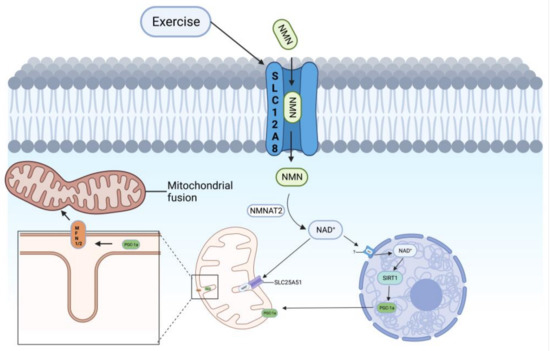
It was previously believed that NMN lacked its own cellular transport pathway and needed to be converted into NR first, which then enters cells via NR-specific transporters before being converted back into NMN.

However, the NMN transporter Slc12a8 was identified in mice, indicating that NMN can be taken up directly from the extracellular space into cells.

Since I happened to have Dingding’s DNA data on hand, I quickly checked and confirmed that humans also carry this gene.

Slc12a8 requires sodium ions to transport NMN, which is why forward-thinking brands include trace amounts of sodium in their formulations.
In addition, exercise promotes the expression of Slc12a8, effectively increasing the number of transport channels—making oral NMN supplementation paired with exercise an ideal combination.
Final Thoughts
Today, we explored several key ingredients that enhance NMN’s efficacy.
A growing body of published research supports the health benefits of combining NMN with other bioactive ingredients. In our laboratory tests, formulations that pair NMN with synergistic partners like PQQ boosted NAD⁺ levels by over 200% compared to NMN alone.
As we are preparing these findings for publication in academic papers and patents, we are not disclosing the specific data in this article.
References
【1】Henderson, J.D., Quigley, S.N.Z., Chachra, S.S. et al. The use of a systems approach to increase NAD+ in human participants. npj Aging 10, 7 (2024). https://doi.org/10.1038/s41514-023-00134-0
【2】Gardell, S.J., Hopf, M., Khan, A. et al. Boosting NAD+ with a small molecule that activates NAMPT. Nat Commun10, 3241 (2019). https://doi.org/10.1038/s41467-019-11078-z
【3】Lan F, Weikel KA, Cacicedo JM, Ido Y. Resveratrol-Induced AMP-Activated Protein Kinase Activation Is Cell-Type Dependent: Lessons from Basic Research for Clinical Application. Nutrients. 2017 Jul 14;9(7):751. doi: 10.3390/nu9070751. PMID: 28708087; PMCID: PMC5537865.
【4】Imai SI. NAD World 3.0: the importance of the NMN transporter and eNAMPT in mammalian aging and longevity control. NPJ Aging. 2025 Jan 27;11(1):4. doi: 10.1038/s41514-025-00192-6. PMID: 39870672; PMCID: PMC11772665.
【5】Camacho-Pereira, Juliana et al.
CD38 Dictates Age-Related NAD Decline and Mitochondrial Dysfunction through an SIRT3-Dependent Mechanism
Cell Metabolism, Volume 23, Issue 6, 1127 - 1139
【4】Chini CCS, Tarragó MG, Chini EN. NAD and the aging process: Role in life, death and everything in between. Mol Cell Endocrinol. 2017 Nov 5;455:62-74. doi: 10.1016/j.mce.2016.11.003. Epub 2016 Nov 5. PMID: 27825999; PMCID: PMC5419884.
【6】Sharma A, Chabloz S, Lapides RA, Roider E, Ewald CY. Potential Synergistic Supplementation of NAD+ Promoting Compounds as a Strategy for Increasing Healthspan. Nutrients. 2023 Jan 14;15(2):445. doi: 10.3390/nu15020445. PMID: 36678315; PMCID: PMC9861325.
【7】Xiao W, Wang RS, Handy DE, Loscalzo J. NAD(H) and NADP(H) Redox Couples and Cellular Energy Metabolism. Antioxid Redox Signal. 2018 Jan 20;28(3):251-272. doi: 10.1089/ars.2017.7216. Epub 2017 Jul 28. PMID: 28648096; PMCID: PMC5737637.


Comments