When it comes to NMN and NAD⁺, this is all you need to know!
Is NMN Really Effective?
NMN’s efficacy has evolved amid over a century of research and debate; its path has been far from smooth, and it was nearly halted early on.
As early as 120 years ago, British scientists first discovered NAD⁺ and gradually confirmed that this coenzyme is central to energy metabolism in animal and human cells. Researchers began to recognize its relevance to muscle function, neural activity, and aging at the cellular level. Then, in 2013, a landmark study from Harvard Medical School found that NMN supplementation effectively raised NAD⁺ levels in older animals and reversed multiple aging markers.
That discovery catapulted NMN into the global spotlight, making it an “anti-aging superstar molecule.” In the years that followed, a wave of preclinical and clinical trial highlighted NMN’s potential in anti-aging, muscle health, cardiovascular function, and neurodevelopment. Anti-aging enthusiasts around the world began embracing NMN supplements.
Shortly thereafter, Japan launched the world’s first human clinical trial on NMN, marking its official transition from animal studies to human application and therapeutic evaluation. A large number of clinical studies have confirmed the efficacy and safety of appropriate NMN supplementation. Subsequently, NMN began receiving food ingredient safety certifications in various countries, including the United States—a critical step in its journey as a dietary supplement.
By 2021, research on NAD⁺’s role in reversing muscle aging had become more robust, with validation in both human and multiple animal models. Boosting NAD⁺ levels was shown to enhance mitochondrial function, reduce amyloidosis, and significantly delay muscle aging, extending healthspan.

In 2022, Zhejiang University published a landmark study. Using a linear aging clock to test various anti-aging interventions on blood samples, researchers found that both metformin and NMN reduced participants’ biological age. Metformin lowered biological age by about 2.5 years, while NMN achieved a reduction of roughly 3.5 years. [1]
Just as NMN was poised for its moment in the spotlight, the brakes were slammed on.
In 2022, the U.S. FDA cited the drug exclusivity provision and ruled that NMN could no longer be marketed as a dietary supplement, as it was being studied as a drug. In September 2025, FDA formally reversed this restriction, allowing NMN to be legally sold again as a dietary supplement.
When news of the ban broke, many media outlets in China began to panic, implying that NMN had been banned because it was unsafe or ineffective.
But just three years later, the tables turned. In September 2025, FDA officially lifted the restriction that NMN could only be used as a drug, granting approval for its sale as a dietary supplement.
As it turns out, a ban can sometimes amplify public interest—and NMN is a prime example. What began as a niche supplement among anti-aging enthusiasts quickly became a nationwide phenomenon, with FDA’s 180-degree reversal serving as an unexpected catalyst. The controversy not only introduced NMN to a wider audience but also underscored its safety and efficacy from a drug-development regulatory perspective.

Is NAD⁺ Essential for Anti-Aging?
Yes, countless compounds have been shown to have anti-aging properties, but they all converge on one core substance: NAD⁺.
As we age, energy metabolism declines—and a key reason is the drop in NAD⁺ levels. Even the most fundamental metabolic pathways, such as the TCA cycle, rely heavily on NAD⁺.
Unfortunately, for many people, NAD⁺ levels begin to fall well before middle age. By ages 40–50, NAD⁺ levels can drop to roughly 50% of peak levels. For those with chronic inflammation, the decline is even steeper. [2]

By age 60 to 70, NAD⁺ levels in the blood of many older adults may fall to just 20–25% of their peak—a finding validated in our own human clinical sampling.
At the core of age-related NAD⁺ decline is a mismatch between synthesis and consumption. In youth, high synthesis and low consumption keep NAD⁺ at a robust dynamic level. With age, synthesis slows while consumption accelerates, causing NAD⁺ levels to steadily drop.
Quick Facts: Why Does Aging Deplete NAD⁺?
Slower Synthesis: NAD⁺ production declines—partly due to factors like NAMPT inhibition—reducing effective synthesis.
Increased Waste: NAD⁺ is consumed in greater quantities by aging- and inflammation-related enzymes such as CD38, leading to inefficient use and greater loss.
Besides Aging, What Else Lowers NAD⁺ Levels?
Inflammation and immune dysfunction.
When the body experiences inflammation or when the immune system is on high alert—responding to senescent cells or pathogens—a cascade of events unfolds.
First, senescent cells release a “toxic” cocktail known as SASP (senescence-associated secretory phenotype). As we age, senescent cells accumulate. These cells no longer divide but remain metabolically active, secreting large amounts of pro-inflammatory cytokines. These inflammatory signals alert the immune system, prompting macrophages to shift toward a pro-inflammatory M1 phenotype to defend the body.
During immune clearance, M1 macrophages require large amounts of CD38, which consumes NAD⁺ to generate second messengers that regulate calcium signaling and activate immune responses. The result? The higher the inflammatory signals and the longer chronic inflammation persists, the faster NAD⁺ is depleted.
So, the fluctuations in NAD⁺ levels throughout a person’s life are essentially a matter of “living off one’s reserves”; the more frequently one falls ill, the faster one depletes NAD⁺, which causes one to age more rapidly than others.
Which Genes Drive NAD⁺ Decline?
CD38 : The Core Depleter
CD38 is a major NAD⁺-degrading enzyme. It directly breaks down NAD⁺ and also depletes its precursor NMN. CD38 is a membrane-bound hydrolase (NADase) whose protein levels and enzymatic activity rise significantly with age. [3]

In contrast, mice with the CD38 gene knocked out—or treated with quercetin to inhibit CD38—showed no decline in NAD⁺ levels at 32 months of age (advanced old age) and exhibited improved glucose tolerance and mitochondrial function. [4]
The Sirtuin Family
The sirtuin family, particularly SIRT1, is highly dependent on NAD⁺ for its activity. SIRT1 regulates a wide range of functions—including glucose and lipid metabolism, mitochondrial function, autophagy, and inflammation—through deacetylation. [5]
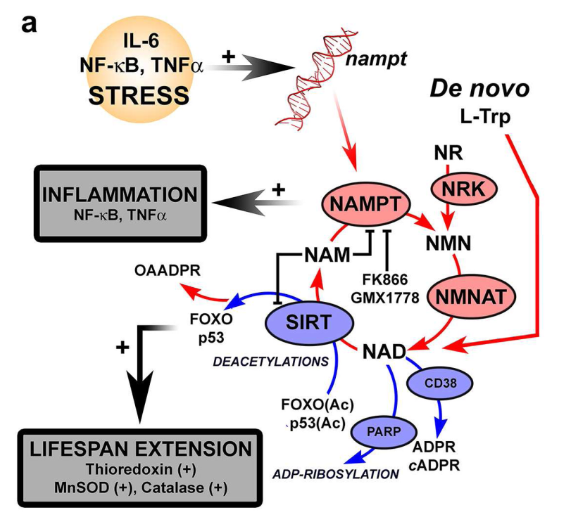
Sirtuins also help regulate CD38 expression. For instance, CD38’s effects on mitochondria are highly dependent on SIRT3.
PARPs (Poly ADP-Ribose Polymerases)
As we age, oxidative damage to cells increases, leading to DNA damage. In response, the body activates PARP enzymes to repair DNA. This repair process consumes large amounts of NAD⁺, causing NAD⁺ levels to drop. Severe DNA damage can even deplete NAD⁺ entirely, triggering a cellular energy crisis. [6]

NF-κB and IL-6 (Pro-Inflammatory Factors)
CD38 expression is regulated by NF-κB. Since low-grade chronic inflammation is a hallmark of aging, inflammation serves as a key driver of CD38 upregulation and subsequent NAD⁺ depletion.
Which Genes Can Increase NAD⁺ Levels?
NAMPT (Nicotinamide Phosphoribosyltransferase)
NAMPT is a highly conserved gene in mammals—and for good reason. Its role is so critical that evolution has kept it largely unchanged.
NAMPT catalyzes the conversion of nicotinamide (NAM) into nicotinamide mononucleotide (NMN) in the NAD⁺ salvage pathway—a critical bottleneck in NAD⁺ recycling. When NAMPT activity is low, NAD⁺ production efficiency drops significantly. When NAMPT is highly active, NAD⁺ recycling becomes much more efficient, ensuring that NAD⁺ metabolites are effectively repurposed.
NMNAT (Nicotinamide Mononucleotide Adenylyltransferase)
Whether NMN is produced endogenously or taken as a supplement, it must be converted to NAD⁺ by NMNAT—making it a second key player in NAD⁺ production.
Together, the activity of NAMPT and NMNAT determines how much NAD⁺ is available inside cells, influencing the function of all NAD⁺-dependent enzymes—including CD38, sirtuins, and PARPs.
If NAD⁺ is the ammunition a soldier needs, then NAMPT is the craftsman making the bullet casings, and NMNAT is the worker loading the gunpowder. Neither can afford to slack off—otherwise, the soldier soon runs out of ammo.
NQO1
NQO1 is another enzyme capable of boosting NAD⁺ levels, earning it the nickname “longevity gene.” Its mechanism is straightforward: during the conversion of coenzyme Q10 from its inactive form (ubiquinone) to its active form (ubiquinol), NQO1 converts NADH to NAD⁺.
In aging animals or humans with liver impairment, NQO1 expression and activity are significantly reduced. Enhancing NQO1 expression helps restore detoxification function and cellular energy levels.
Then there is the Slc12a8 gene, the NMN transporter mentioned earlier. What you may not realize is that the human body is also fighting against aging. Small intestinal cells actively increase the expression of Slc12a8 to boost NMN transport in response to declining NAD⁺ levels. This is a crucial feedback mechanism that has evolved in both animals and humans to maintain NAD⁺ homeostasis.

But relying solely on the body’s own mechanisms isn’t enough to reverse the decline in NAD⁺ levels---otherwise, NAD⁺ wouldn’t drop with age in the first place. That’s why we need external compounds to enhance Slc12a8 transport efficiency, and sodium ions are the ideal catalyst.
The Most Direct Benefits of Boosting NAD⁺
Ultimately, boosting NAD⁺ aims to slow aging. But anti-aging is a broad concept. NAD⁺ works on four distinct levels.
1. Genetic Level: DNA Repair and Genome Stability
NAD⁺ serves as a critical substrate for key RNA polymerases, helping reduce mutations, repair DNA, stabilize chromatin structure, and suppress transposon activity—all of which contribute to maintaining genome integrity.
2. Cellular Level: Energy Production and Autophagy
As a core coenzyme in redox reactions, NAD⁺ plays a central role in mitochondrial processes such as the TCA cycle and oxidative phosphorylation, which together account for about 60% of the body’s ATP production. NAD⁺ also regulates autophagy through the sirtuin family.
3. Organ Level: Metabolic Improvement and Aging Delay
NAD⁺ supports multiple systems, including the nervous system, cardiovascular system, liver, and metabolism. It shows particular promise in reducing cardiomyocyte death after myocardial infarction, improving vascular elasticity and blood pressure, enhancing insulin sensitivity, regulating fat metabolism, and improving egg quality.
4. Athletic Performance: Endurance and Muscle Function
Athletic performance is one of the most extensively studied areas in NAD⁺ clinical research—largely because age-related muscle loss is a major concern.
If you’re wondering where the most noticeable effects can be felt, clinical data offers a clue. A multicenter, randomized, double-blind, placebo-controlled study involving 66 healthy middle-aged and older adults found that just 60 days of NMN supplementation increased endurance by 6.5%.

Why Isn’t NMN Supplementation Working for You?
1. Single-Ingredient NMN Without Encapsulation or Penetration Technology
Ordinary NMN without encapsulation technology is highly susceptible to degradation in the acidic environment of the stomach—up to 70% may be intercepted by stomach acid and the liver. Moreover, cellular uptake of NMN has a saturation point; excessive supplementation can actually become counterproductive, potentially triggering inflammatory responses.
2. Focusing Solely on NAD⁺ Intake While Ignoring Bioavailability and Safety
The conversion of NMN to NAD⁺ involves complex metabolic pathways. High-dose NMN supplementation may lead to several issues: excess NMN can degrade into nicotinamide (NAM), which may inhibit sirtuin activity and increase liver burden. Additionally, unmetabolized NMN could theoretically fuel cancer cell growth, as NAD⁺ supports energy metabolism in all cells—including cancerous ones.
3. Exaggerated Label Claims and Ingredient Shortfalls
Independent testing has revealed significant discrepancies in actual NMN content. In one third-party analysis of 22 NMN products, 14 contained less than 1% of the claimed NMN content, and some tested undetectable. Some products boast “99.9% NMN purity”—but that refers to the purity of the raw ingredient, not the actual amount in the product. It’s like buying a shirt labeled “100% cotton” only to find it contains just a trace of cotton. What you’re paying for is often just a concept.
Why High-Dose NMN Alone Isn’t Recommended
Many people assume that taking more NMN—or NR—will automatically lead to higher NAD⁺ levels, even if conversion efficiency is low. Supplement manufacturers are well aware of this mindset, which is why you’ll often see products boasting 10,000 IU per bottle or 500–1,000 mg per capsule.
But is more really better? A growing body of research suggests otherwise. Here are a few reasons to reconsider the “more is more” approach.
NRK genes encode essential rate-limiting enzymes for converting NR and NMN into NAD⁺ in mammalian cells. Studies show that when NRK expression is elevated, NAD⁺ production from NR/NMN increases significantly. Conversely, when NRK genes are mutated, NR supplementation fails to raise NAD⁺ levels. [8]

In tissues such as the liver, kidneys, and brown adipose tissue, NRK mutations are especially detrimental to NAD⁺ production, significantly reducing synthesis efficiency in these organs.

Slc12a8 is a specific NMN transporter. Loss of Slc12a8 significantly reduces intestinal NMN uptake and NAD⁺ levels. Even at high oral doses of 500 mg/kg, NMN entry into cells is greatly diminished when Slc12a8 expression is low. [9]

While NMN supplementation can be highly beneficial for anti-aging, not everyone is suited for standalone NMN or NR supplementation—especially at high doses. If you have certain genetic mutations combined with a single-ingredient formulation, you may not only miss out on anti-aging and muscle benefits but also experience unintended side effects.
Can People with Diabetes Take NMN?
Yes. NMN-based supplements can improve insulin sensitivity.
A 2021 study published in Science involved a randomized, double-blind, placebo-controlled trial in overweight or obese postmenopausal women with prediabetes. After 10 weeks of NMN supplementation at 250 mg per day, the results showed improved muscle insulin sensitivity, insulin signaling, and muscle remodeling. [10 ]

Should Cancer Patients Avoid NMN?
Traditionally, we have advised cancer patients to exercise caution with NAD⁺-boosting supplements. There are two main concerns:
First, tumor cells have higher energy demands than healthy cells. NMN supplementation could potentially raise NAD⁺ levels in cancer cells, fueling their rapid division and proliferation.
Second, certain cancer treatments may inhibit key enzymes—including NMNAT (the enzyme that converts NMN to NAD⁺). In such cases, supplementing with NMN may not only fail to generate NAD⁺ but could also lead to NMN accumulation, potentially causing nerve damage. [11]
However, recent research suggests a more nuanced picture. Scientists have begun to explore whether NMN might actually support—rather than hinder—cancer treatment.
In immunotherapy for breast and lung cancer, T-cell infiltration is a critical predictor of response. Whether a patient responds to immunotherapy often determines treatment success—and many fail to respond.
Last year, a research team from Fudan University found that NMN supplementation not only restored the anti-tumor function of specific T cells but also significantly improved cancer treatment outcomes when combined with PD-1 inhibitors. [12]
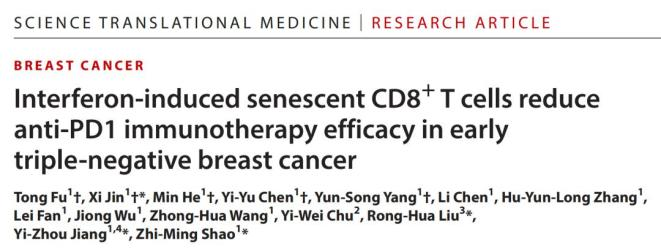
Despite these promising findings, we still do not recommend NMN supplements for cancer patients—especially those undergoing radiation therapy, chemotherapy, or with metastatic cancer.
What Are the Advantages of NAD⁺ 8-IN-1?

First, UNILIPO NAD⁺ 8-IN-1 uses liposomal encapsulation for NMN, quercetin, PQQ, and other key ingredients to greatly enhance bioavailability.
Additionally, sodium acetate is included to help NMN cross the cell membrane and enter the mitochondria, maximizing its effective utilization.
Second, the formulation is designed to address the entire metabolic pathway, optimizing NMN utilization:
L-ergothioneine improves NAD⁺ energy turnover efficiency. PQQ + EGCG rapidly enhance mitochondrial biogenesis and help maintain NAD⁺/NADH balance. Quercetin inhibits CD38, reducing inflammation-driven NAD⁺ depletion. R-lipoic acid blocks NNMT-mediated methylation loss, ensuring efficient NAD⁺ recycling and regeneration.
TMG provides methyl donors, supporting the smooth operation of the entire system.
The formulation works like a finely tuned machine—each component interconnected and synergistic.
Third, and often misunderstood, excessive intake of any single ingredient can cause side effects. That’s why NAD⁺ 8-IN-1 doesn’t chase “megadose” trends for NMN or any other ingredient. Instead, the goal is to maximize in vivo utilization.
Every ingredient—L-ergothioneine, PQQ, R-lipoic acid, quercetin, and others—is added at clinically effective doses, with no shortcuts and no under-dosing. That’s how we ensure results.

Each of these eight ingredients also has its own specific function.
The 8 Components' Roles:
NMN: Provides the direct precursor
TMG: Maintains methyl balance
Quercetin: Protects NAD⁺ from excessive depletion
R-Lipoic Acid & PQQ: Activate NAMPT to promote NAD⁺ conversion
L-Ergothioneine: Facilitates NADH/NAD⁺ conversion
EGCG: Creates and maintains a healthy cellular environment for NAD⁺ synthesis, function, and stability
PQQ: Increases mitochondrial number, boosting NAD⁺ demand and utilization
NaOAc: Ensures effective delivery and stability of NMN
The Core Mechanism of NAD⁺ 8-IN-1
The eight active ingredients in NAD⁺ 8-IN-1 work together like the “Eight Immortals Crossing the Sea”—each with its unique strengths, but all heading toward the same goal: to effectively raising NAD⁺ levels and utilization.
From a mechanistic standpoint, the challenge lies in coordinating the entire signaling pathway to function efficiently. But in simple terms, it comes down to addressing four key targets:
1. Activate NAMPT and NMNAT to make NAD⁺ synthesis and recycling more efficient.
2. Inhibit CD38 and NNMT to plug the leaks in NAD⁺ depletion.
3. Stabilize SLC12A8 to keep the NAD⁺ entry channel open.
4. Balance the NAD⁺/NADH ratio to regulate cellular oxidative metabolism.
Glossary
NAMPT: The rate-limiting enzyme in the NAD⁺ salvage pathway; often called the “NAD⁺ recycling pump.”
CD38 and NNMT: NAD⁺-consuming enzymes that contribute to NAD⁺ decline.
SLC12A8: A specific NAD⁺ transporter responsible for intestinal uptake of NAD⁺ precursors.
NAD⁺/NADH Ratio: A core indicator of cellular redox state, influencing energy metabolism and oxidative stress.
To use a simple analogy: NAD⁺ in the body is like the water level in a reservoir. As we age or develop chronic inflammation, the supply of fresh water upstream diminishes, and the reservoir itself develops cracks and leaks. The water level drops, and what remains isn’t effectively circulated for use downstream.
By targeting multiple aspects of this system with eight clinically effective ingredients, we repair and renovate the reservoir, restore circulation, and ensure that NAD⁺ is effectively utilized downstream. That’s what true anti-aging looks like.
Thus, the formulation’s overall benefits revolve around three goals: systematically, comprehensively, and effectively boosting NAD⁺ levels and utilization.

Mechanism 1: Increasing Supply – Fresh Water Inflow, Efficient Recycling
NMN serves as the direct precursor and driving force behind NAD⁺ production—the fresh water added to the reservoir. It rapidly raises NAD⁺ levels, providing ample raw material for cellular energy generation.
R-Lipoic Acid (R-LA) and PQQ act as the “power pumps” for NAD⁺ recycling. By activating NAMPT—the key rate-limiting enzyme that converts nicotinamide into NAD⁺—they enhance NAD⁺ self-regeneration and boost circulation efficiency.
NaOAc acts as a “pressure regulator” for NAD⁺ delivery. By enhancing SLC12A8 transporter activity, it facilitates smooth NMN entry into cells, ensuring that intracellular transport pathways remain clear.
Mechanism 2: Enhancing Utilization – Maintaining Efficient Dynamic Circulation
L-Ergothioneine (L-EGT) acts as a “flow optimizer” and “anti-rust coating” for the reservoir. It optimizes NAD⁺-dependent metabolism while protecting cells from oxidative stress, improving energy turnover and preventing cellular “rust.”
PQQ + EGCG serve as the “energy core valves,” promoting mitochondrial biogenesis and maintaining NAD⁺/NADH balance. This creates the “pressure gradient” needed for reservoir circulation, delivering more efficient energy output and putting an end to metabolic fatigue.
Mechanism 3: Reducing Waste – Plugging Leaks, Protecting the System
Quercetin acts as a “leak sealer” for the reservoir by potently inhibiting CD38. In aging individuals or under chronic inflammatory conditions, CD38 aggressively consumes NAD⁺, leaving insufficient NAD⁺ for energy production. Inhibiting CD38 reduces this major “leak,” preserving more NAD⁺ for essential functions like DNA repair.
EGCG and R-Lipoic Acid work together to seal the reservoir’s numerous micro-cracks. Their combination effectively blocks NNMT-mediated methylation loss, ensuring that nicotinamide (NAM) remains in the recycling loop rather than being metabolized and excreted—thereby safeguarding NAD⁺ regeneration.
TMG functions as a “water purifier” for the entire reservoir system. Many fundamental physiological processes require adequate methyl groups. As we age, TMG provides the necessary methyl donors to replenish those consumed during NAD⁺ metabolism, keeping the system clean and running efficiently.
The end result is not just higher NAD⁺ levels, but a fully renovated reservoir operating at peak efficiency.
Clinical Trials Show Significant NAD⁺ Boosting
Animal studies
To validate the efficacy of NAD⁺ 8-IN-1 , we compared it against traditional NMN alone across multiple parameters. Both NMN alone and NAD⁺ 8-IN-1 were administered at 200 mg/kg body weight (note: in the 8-IN-1 group, NMN content was equivalent to 50 mg/kg). Mice received daily oral gavage, and blood samples were collected at 0, 12, 24, and 72 hours.
The results showed that at 12, 24, and 72 hours, both NMN alone and NAD⁺ 8-IN-1 significantly increased NAD⁺ levels in mouse blood. However, NAD⁺ 8-IN-1 consistently achieved significantly higher levels at all three time points. At the 72-hour endpoint, NMN alone increased NAD⁺ by over 100% compared to the control group, while NAD⁺ 8-IN-1 achieved an increase of nearly 300%.
Importantly, NAD⁺ 8-IN-1 contained only one-quarter the amount of NMN compared to the NMN-only group—yet it delivered more than double the NAD⁺-boosting effect.

Why does the formulation achieve significantly better results with less NMN? Let's start by looking at the expression changes of two key genes in NAD⁺ synthesis: NAMPT and NMNAT.
NAMPT is the rate-limiting enzyme in the NAD⁺ salvage pathway, responsible for converting nicotinamide (NAM) into NMN. NAD⁺ 8-IN-1 upregulates NAMPT expression, while traditional NMN alone has no activating effect on NAMPT.

The other key gene is NMNAT, which drives the conversion of NMN to NAD⁺. In the NAD⁺ 8-IN-1 group, NMNAT expression increased by approximately 20%, indicating a significant improvement in NAD⁺ conversion efficiency. Interestingly, in the NMN-only group, NMNAT levels decreased at the 24- and 72-hour time points.

In other words, when the body senses high-dose NMN intake, it may actually “hit the brakes” to reduce physiological stimulation—which may help explain why high-dose NMN alone doesn’t always deliver proportional benefits.
NQO1 promotes the conversion of NADH to NAD⁺, thereby lowering the NADH/NAD⁺ ratio. The results showed that NQO1 expression was significantly increased in the NAD⁺ 8-IN-1 group, while the NMN-only group showed no effect.

These blood and gene expression charts may look simple, but they clearly illustrate how NAD⁺ 8-IN-1 works differently from NMN alone.
Human Trial
If the animal study left any questions, the human clinical results are even more straightforward. Eighteen volunteers with an average age of 44.5 years took NAD⁺ 8-IN-1 capsules for one month at a daily dose of 250 mg (two capsules each morning). Results showed that after one month, average blood NAD⁺ levels rose significantly from 48 μmol/L to 70.7 μmol/L—an average increase of 47.3%.

The study also confirmed that age and chronic disease are directly correlated with NAD⁺ levels. Participants who were older or had metabolic conditions such as diabetes started with lower blood NAD⁺ levels. After one month of supplementation, NAD⁺ levels increased to varying degrees across all participants.

Why Not Supplement NAD⁺ Directly?
NAD⁺ has a large molecular weight and carries a negative charge, making it unable to cross cell membranes. Additionally, it is rapidly degraded in the digestive tract. Oral NAD⁺ is quickly broken down into nucleotides and other fragments in the gut, preventing it from reaching the bloodstream in its active form.
Thus, direct NAD⁺ supplementation suffers from inherently low bioavailability and an inability to penetrate cell membranes—two fundamental barriers that make precursor supplementation the only viable approach.
What’s the Difference Between NR and NMN?
Both NR and NMN are effective small-molecule precursors that enter cells through specific transporters and ultimately convert to NAD⁺. However, NMN generally offers advantages in absorption speed, conversion efficiency, and stability, making it the most direct and effective way to boost NAD⁺.
Why Not Supplement NADH?
Whether NADH supplementation promotes longevity or accelerates aging remains unresolved. While NAD⁺ and NADH can interconvert, a higher NAD⁺/NADH ratio is generally more favorable for NAD⁺-dependent functions. From this perspective, lower NADH levels—rather than higher—are desirable.
Most critically, NADH levels actually increase with age in humans, so NADH deficiency is not a concern. (This is a key point worth remembering.) In fact, NADH concentration correlates positively with age, whereas only NAD⁺ levels show a clear inverse correlation. [13]
This is why we emphasize the importance of raising the NAD⁺/NADH ratio in healthy individuals—rather than focusing on boosting any single molecule in isolation.
Final Thoughts
After reading this article, you might feel that with NAD⁺ 8-IN-1 —a true “nuclear option” for anti-aging—the battle against aging finally has a fighting chance. And you’d be right. When it comes to slowing aging, having adequate NAD⁺ is absolutely essential.
But here’s something you might not realize: aging doesn’t start in old age. It begins much earlier—while we’re still young. Why don’t we feel it?
Because in a healthy, young state, the body maintains high, stable NAD⁺ levels. Sirtuins—the longevity proteins—have plenty of NAD⁺ to keep things running smoothly.
In aging or chronic inflammation, however, CD38 on immune cells punches a massive hole in the bottom of the reservoir. No matter how much NMN you add through the inlet pipe, it gets instantly consumed by overactive immune cells, leaving little NAD⁺ for sirtuins and DNA repair.
So, simply boosting NAD⁺ isn’t enough. You also need to balance your immune system—keeping it alert but not overactive—so that you can maintain the upper hand in the long-term battle for youth.
On a personal note, I’ve been taking NAD⁺ 8-IN-1 for a while. During a recent trip over the Lunar New Year, I noticed something unexpected: hiking up the Great Wall and tackling other endurance activities left me feeling completely energized. No fatigue at all.


Comments