The Secret to Better Skincare Results – with the Same Routine
Transdermal Absorption – The Key to Skincare Effectiveness
The skin’s primary function is defense — it keeps foreign substances out and prevents the body’s own moisture and nutrients from escaping. In other words, the skin isn’t designed to absorb.
This makes it inherently difficult for active ingredients — whether from drugs or skincare — to penetrate the skin and do their job.
For active ingredients to be absorbed, there are two main routes: the epidermal pathway and the appendageal pathway.
The appendageal pathway involves absorption directly through hair follicles, sweat glands, and other skin appendages. The epidermal pathway, by contrast, requires ingredients to pass through the stratum corneum, then into the basal layer, the dermis, and even the subcutaneous fat layer. This is the primary route of transdermal absorption, accounting for approximately 80–90% of total absorption.
The epidermal pathway can be further divided into two sub‑routes: transcellular and intercellular. The transcellular route goes through corneocytes, while the intercellular route travels through the lipid bilayers between them. Between the two, the intercellular pathway accounts for the majority of ingredient absorption.

The diagram below provides a simplified overview of these absorption pathways.
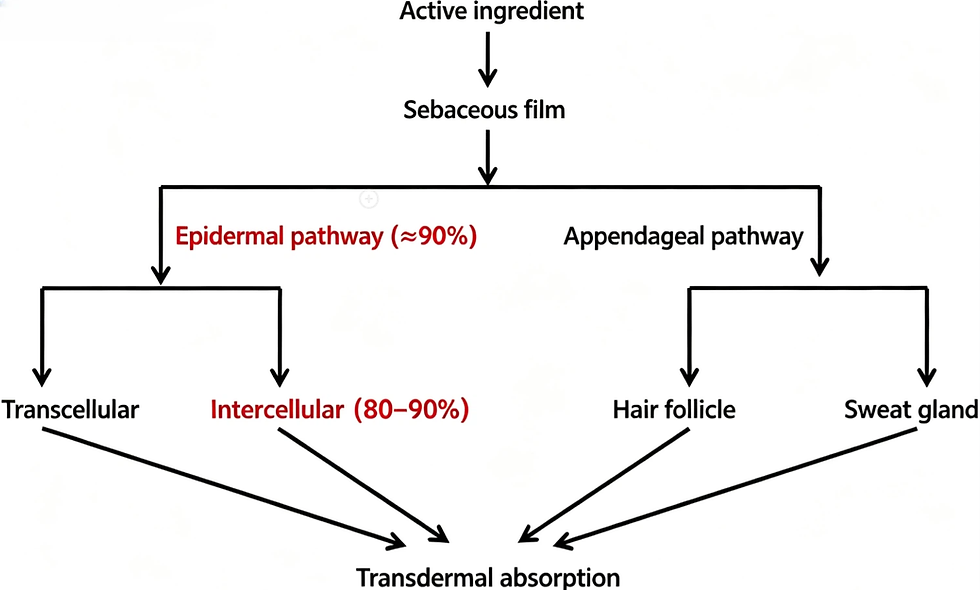
In other words, among all transdermal routes, the intercellular pathway – though it may seem more winding – is actually the fastest and most efficient.
However, the road through the skin isn't just winding; its outcome isn't always successful. Active ingredients diffuse slowly through the stratum corneum and may even be metabolized by microbes before they reach the dermis.
So, getting skincare ingredients to penetrate the skin effectively remains a major challenge.
Don’t think of your sebum film and stratum corneum as barriers that block expensive skincare from absorbing – they’re actually there to protect you. That’s why children’s skincare requires richer moisturization – kids have thinner barriers, less sebum, and a weaker moisture layer, so water escapes easily, leaving skin extremely dry and prone to eczema. In many ways, adult dry, sensitive skin shares similar characteristics with children's skin – a thinner barrier and weaker moisture retention – which is why both benefit from extra care.

Why Your Skincare Needs a Booster Serum
Most ingredients rely on the intercellular pathway for absorption, which leaves two options:
First, widen the intercellular route or clear the obstacles along the way. Second, create more of these pathways.
Ethanol (alcohol) – one of the earliest ingredients used in skincare – was developed specifically to "clear the way."
Alcohol disrupts the intercellular lipid bilayers in the stratum corneum, loosening the matrix and creating larger gaps between cells. As a result, active ingredients can penetrate the skin more easily.
Beyond its effect on the intercellular matrix, alcohol also removes the oily sebum film, making it easier for water‑soluble ingredients to penetrate.
Later, "boosting serums" (or pre‑serums) emerged on the skincare scene, claiming to open up absorption pathways and enhance the penetration of active ingredients.
In 2009, Lancôme launched its Génifique serum – a booster formula in which ethanol and HEPES (hydroxyethylpiperazine ethane sulfonic acid) are the key penetration‑enhancing actives.

The success of Génifique sparked a wave of interest across the industry. Many brands followed suit, flooding the market with penetration‑boosting products featuring ethanol and Bifida ferment lysate, all marketed as pre‑serums or booster essences with enhanced absorption claims.
To this day, whether these products actually work remains a topic of debate. Some dismiss them as a marketing gimmick. But it's hard to deny that with the right penetration‑enhancing ingredients, achieving several times higher absorption is no empty claim.
While alcohol can boost absorption, the harm it causes to skin should not be overlooked. From its early days as a widely used skincare ingredient, it has increasingly fallen out of favor.
Safe Ingredients that Boost Absorption
Alcohol’s impact on skin health can be irreversible in the short term. So are there gentler alternatives? Absolutely.
Bifida Ferment Lysate – A complex fermented ingredient that helps support the skin's natural barrier and microflora, while mildly promoting desquamation to aid penetration.
Azone – A classic penetration enhancer used in both pharmaceuticals and skincare. While it may cause mild irritation, it is generally gentler than alcohol over the long term.
Dimethyl Isosorbide (DMI) – DMI interacts with skin lipids, helping create temporary permeation pathways in the stratum corneum to aid transdermal absorption of active ingredients.
Volatile Oils (e.g., Peppermint Oil) – Peppermint oil or menthol reversibly alters lipid arrangement in the stratum corneum, enhancing ingredient penetration. This is commonly used in scalp serums or fastacting pain relief products.
Tetrahydropiperine – A relatively newer penetration enhancer that effectively promotes absorption of various compounds – including polyphenols, alkaloids, flavonoids, and vitamins like A and C. Its mechanism of action is straightforward: tetrahydropiperine reversibly enhances lipid membrane fluidity by temporarily altering the lipid bilayer arrangement, thereby facilitating diffusion through intercellular spaces.
Studies show that tetrahydropiperine outperforms traditional enhancers like Azone. For example, in glabridin penetration tests, 0.04% tetrahydropiperine delivered 1.6 times the permeation rate of Azone, and over 5 times that of the compound alone.

It enhances the affinity of water‑soluble ingredients for lipid cell membranes, further shortening permeation time. A process that typically takes 24 hours can be completed in just 4 hours with the same dose of tetrahydropiperine. Clinical trials confirm that when applied topically, tetrahydropiperine significantly boosts the penetration and absorption of active ingredients.

For example, when betamethasone dipropionate is applied to the skin, less than 30% penetration is detected after 45 minutes. But when combined with tetrahydropiperine, near-complete penetration occurs within just 5 minutes.
Tetrahydropiperine also offers two additional benefits: very low irritation and efficacy at low concentrations. As little as 0.01% can improve the skin’s absorption and utilization of active ingredients, while even up to 0.1% does not cause long‑term irritation.
Excellent Pre-Serum – Your Skincare's Best Partner
UNILIPO Acetyl Zingerone Antioxidant Penetrating Essence contains up to 0.05% tetrahydropiperine. But penetration enhancement alone doesn't make a truly great pre‑serum.
Many active ingredients in serums — such as vitamin C (ascorbic acid), retinoids, and pterostilbene — can become unstable and lose efficacy when exposed to UV light after application (vitamin C derivatives are somewhat better, but can still cause skin yellowing by afternoon). This is where a stabilizing ingredient comes in: acetyl zingerone.

Acetyl zingerone is one of the most powerful antioxidants available. It physically quenches reactive species and selectively chelates metal ions, making it one of the most comprehensive antioxidant ingredients.
For example, its efficiency in scavenging singlet oxygen, hydrogen peroxide, hydroxyl radicals, and peroxynitrite is 18–127 times that of vitamin E, and 158–470 times that of resveratrol.
But it also has a hidden benefit: it helps stabilize and enhance the absorption of other ingredients. Studies show that acetyl zingerone can stabilize vitamin C precursors, indirectly boosting the efficacy of other actives. It can also stabilize ingredients like vitamin C and pterostilbene, extending their activity and reducing their potential pro‑inflammatory effects.
Moreover, it retains over 90% activity even under UV exposure, making it especially effective in daytime serums and moisturizers. It also helps protect DNA from UV‑induced damage.

In addition to tetrahydropiperine for enhanced penetration, and acetyl zingerone for stabilization, this pre‑serum also contains up to 10% of the C3Px complex. The C3Px complex – featuring bakuchiol, ectoine, and Argireline® – is considered one of the most powerful anti‑aging blends currently available in serums.
Also included is AQUAXYL® from SEPPIC, a xylitylglucoside complex that boosts the expression of aquaporin‑3 (AQP3) and caspase‑14 (a filaggrin hydrolase). This enhances natural moisturizing factor production, increases hyaluronic acid synthesis, and helps the skin transport moisture more efficiently.
Clinical trials confirm its strong moisturizing and repair benefits. In one study, after 30 days of use, transepidermal water loss dropped by 14%, and skin became visibly smoother.

As a pre-serum, skin feel and texture are what truly make or break the experience. It needs to hydrate instantly and absorb in a flash – melting into a lightweight, water-like finish the moment it touches your skin.

If your skincare routine feels like it's reached a plateau, adding a pre-serum may help maximize the performance of the products you already use, helping your skin look brighter, smoother, and more even-toned.
Together, these technologies form the foundation of UNILIPO's pre-serum formulation.
Designed to complement your existing skincare routine, the UNILIPO Pre-Serum helps enhance ingredient delivery while providing antioxidant protection. Apply it after cleansing and before your serums or creams to help your existing routine perform at its best - without changing the products you already love.


Comments